

Joe Satriani
Along with teaching some of the top rock guitar players of the '80s and '90s, Joe Satriani is one of the most technically accomplished and widely respected guitarists to emerge in recent times. Born on July 15, 1956, in Westbury, NY, and raised in the nearby town of Carle Place, Satriani -- inspired by guitar legend Jimi Hendrix -- picked up the guitar at the age of 14 (although he was initially more interested in the drums). Quickly learning the instrument, Satriani began teaching guitar to others and found a kindred spirit in one of his students, Steve Vai. By the late '70s, however, Satriani had relocated to Berkeley, CA. With his sights set on his own musical career, "Satch" kept teaching others, including such future rock notables as Kirk Hammett (Metallica), Larry LaLonde (Primus), David Bryson (Counting Crows), and jazz fusion player Charlie Hunter.
Steve Vai
Steven "Steve" Siro Vai (born June 6, 1960 in Carle Place, New York) is an Italian American instrumental rock guitarist, songwriter, vocalist, producer, beekeeper, and actor. After starting his professional career as a music transcriptionist for Frank Zappa, Vai would also record and tour in Zappa's backing band starting in 1980. The guitarist began a solo career starting in 1984 and has released 13 solo albums as of 2008. Apart from his work with Frank Zappa, Vai has also recorded and toured with numerous musical artists including Alcatrazz, David Lee Roth and Whitesnake. Vai has been a regular touring member of the G3 Concert Tour which began in 1996. In 1999 Vai started his own record label Favored Nations with the intent to showcase, as Vai describes: "...artists that have attained the highest performance level on their chosen instruments."
Saul "slash" Hudson
SLASH was born in Hampstead (London), England on July 23, 1965, and he was raised in Stoke-On-Trent, Staffordshire, England. His given name is Saul Hudson. His mother is a Black American, and his father is a white Englishman. Both parents are artistic and work in the entertainment field. His mother is a clothing designer for entertainers. She designed some of David Bowie's unforgettable costumes. His father provides art direction for record albums. Two notable clients are Neil Young and Joni Mitchell.
At age 11 SLASH moved to Los Angeles with his mother while his father remained based in England. Born in the UK, SLASH was an immigrant in the United States and was to remain one for many years. The family eventually lived together again in L.A. where SLASH had a rough transition to conservative Southern California. The long hair, jeans and t-shirts that he wore even then didn't exactly fit with the other kids. An outsider at school, he lived a bohemian life at home. Surrounded by artistic friends of his parents, SLASH grew accustomed to the moods and eccentricities of those in the music world. Frequent visitors at the Hudson household included Joni Mitchell, David Geffen, David Bowie, Ron Wood
and Iggy Pop. SLASH has said that these surroundings prepared him for coping with the stress of the music industry, the conflict between artistry and business.
In the mid-1970's, his parents separated. SLASH moved in with his beloved grandmother until he could sort out the situation at home. About this time SLASH discovered BMX (bicycle motorcrossing), joined up with a group of kids, and rode with a passion. It's not surprising to hear that SLASH would ride without brakes! SLASH eventually became a professional BMX biker winning awards and money for his great riding.
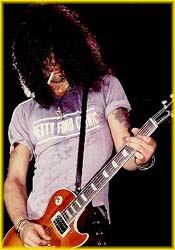
Soon the bike was put aside. SLASH devoted at least 12 h
ours a day to playing guitar. His schoolwork suffered when he skipped classes and sat in the bleachers all day playing guitar. School may have suffered, but his social life got better! The other kids now thought SLASH was cool, and he was no longer a social outcast. SLASH joined band after band jamming with other young musicians. Eventually, SLASH gave up on school and dropped out in eleventh grade. Another education was waiting for him in the L.A. band scene. SLASH met Steven Adler, formed the band Road Crew, and was looking for a good singer. Then he met Izzy Stradlin who played him a tape of W. Axl Rose singing. SLASH went to see Axl perform and immediately wanted to steal him from Izzy, but the two Indiana natives were fast friends. SLASH found his bass player in Duff McKagan when Duff answered an ad SLASH had placed in the paper. All the players changed combinations, but the result was Guns N'Roses! With a lot of talent and a lot of drive, the band became an international success story.
After the Illusions tours, Guns N'Roses went on a well-deserved hiatus, an
d SLASH became a U.S citizen. He decided that immigration hassles, lost green cards, etc. were just too timeconsuming for his lifestyle. So SLASH became a citizen of the United States. Welcome, SLASH! About this time, SLASH became restless and decided to form a new band as a side project to his GNR work which seemed to be taking forever to get started. Matt Sorum, Gilby Clarke, Mike Inez, Eric Dover, and SLASH formed SLASH's Snakepit and recorded the album IT'S FIVE O'CLOCK SOMEWHERE. Never content to stay home and smell the roses, SLASH went on the road with his touring band: Gilby Clarke, Brian Tichy, James Lomenso, Eric Dover. Playing to small venues, SLASH was able to get back to playing in clubs and being toe-to-toe with the audience. IT'S FIVE O'CLOCK SOMEWHERE went platinum worldwide, and SLASH promised that Snakepit would be back again.
In the summer of 1996, SLASH was invited to play at a blues concert in Budapest, Hungary. He got together some musicians and headed for Europe. From this beginning came a terrific band called SLASH's Blues Ball. And though this band never recorded an album, it was in big demand by promoters and fans.While this was going on, SLASH was waiting for Axl Rose to get Guns N'Roses together. SLASH and Axl had talks about the musical direction of the band. SLASH saw GNR as a rock band while Axl Rose wanted to go in a more techno/industrial direction with GNR. After many, many meetings and heat ed discussions, SLASH resigned from GNR in October 1996 with Rose retaining the rights to the band name. SLASH didn't sit at home with his head in his hands. He got busy with Blues Ball! Blues Ball played blues covers, so they could start playing gigs right away. Throughout the end of 1996 till the fall of 1997, SLASH's Blues Ball played at clubs throughout California, into the southwest and the northeast. Blues Ball has rolled away for the time being but may play some one-offs. You just never know with SLASH!
When SLASH left Guns N'Roses, his many fans wondered what he
 might be going do with all that talent and personality. The media were wondering, too. At first, there was speculation that the Axl - SLASH rift would be of short duration and a reconciliation was inevitable. SLASH had been quoted as saying that when Axl Rose was ready to make a rock and roll album, he would be back. As Rose filled GNR with hired guns and unknowns, SLASH made it clear that Snakepit will be his permanent band. He says he could do a one off or a short tour with the original band, but he would never walk on stage with a band pretending to be the Guns N'Roses band.
Yngwie Johan Malmsteen
Yngwie J. Malmsteen arrived on the scene in 1983 when he emigrated to America from his native Sweden. Malmsteen created a style - an ear-searing blend of metal bombast and classical beauty that is one of the most immediately recognizable of ALL guitarists. He elevated classical chops to new heights, adding a definite European stamp both dark-sounding and blindingly fast. "I've been exposed to classical music since I was five years old," says Yngwie, who was born in Stockholm on June 30, 1963. "My mother listened to Bach so much, and I grew to really love his music. Bach's chord progressions and melodies are the most beautiful things ever written. "My family was very musical," he adds. "My sister played flute and piano and my brother played guitar, drums, piano, violin, and accordian. My father even played guitar." Malmsteen maintains that his biggest classical influence is 19th-century violin virtuoso Nicolo Paganini. "I was in my early teens the first time I heard his music," recalls Yngwie," and he's been my idol ever since. I got turned on to him through a Swedish TV show. A Russian violinist was playing some Paganini stuff on the program, and I freaked. I quickly put a portable tape recorder in front of the TV to get it on tape. When I fou nd out later what the guy was playing, I went out and bought Paganiniâs "24 Caprices," which is my all-time favorite thing to listen to. "Thatâs how I wanted to play guitar. He did with his instrument what few have ever come close to doing. He was a rock and roller-very wild and very extreme." Yngwie's work overflows with classically influenced playing. His Grammy-nominated debut solo album, "Yngwie J. Malmsteen's Rising Force," is regarded by many as the definitive document of neoclassical rock guitar. "Those compositions ["Black Star" and "Far Beyond the Sun"] sort of sum up my style," says Yngwie. "There are fast runs, slow harmonies, and some really nice arpeggios in them. Those songs are like icons for me. I'll probably play them until the day I die." Malmsteen first picked up a guitar on September 18, 1970-the day Jimi Hendrix died. "Hendrix did inspire

John Petrucci
John started experimenting with a seven string guitar on the album "Awake" which he believes made the album a bit heavier. He does a lot of writing at home in his four track studio and brings a sequencer on the road with him. When not wrapped up with music, John enjoys exercising, boating, biking and eating. John lives with his wife, Rena, and 3 children, SamiJo, Reny and Kiar
 a in New York. When he's not playing guitar he spends most of his time with his wife and children inline skating, biking.Born on July 12, 1967, John Petrucci was raised in a musical family in Long Island, New York. Although his parents do not play instruments, his older sister played piano and organ, his brother plays bass and his younger sister plays clarinet. While his sister inspired some of his interest in music, John says the main reason he picked up the guitar was because all the kids in his neighborhood were playing and it looked like fun.
Paul Gilbert
Metal guitar virtuoso Paul Gilbert was born November 6, 1966 in
 Carbondale, IL and raised primarily in Greenburg, PA; he began playing music at age five, and by age 15 was not only touring local clubs with his band Tau Zero but was even spotlighted in Guitar Player magazine alongside fellow up-and-comer Yngwie Malmsteen. In 1984 Gilbert relocated to Los Angeles to attend the Guitar Institute of Technology, becoming an instructor there the following year; concurrently he formed the band Electric Fence, which by 1986 evolved into Racer X. Their debut album Street Lethal appeared later that year, but in the wake of the follow-up, 1987's Second Heat, Gilbert exited to join Mr. Big, which in 1992 topped the pop charts with the ballad "To Be with You." Mr. Big disbanded in 1996, and a year later Gilbert made his solo debut with King of Clubs; Flying Dog followed in 1998, trailed by Beehive Live in 1999 and Alligator Farm in fall 2000. ~ Jason Ankeny, All Music Guide




0 comments:
Post a Comment